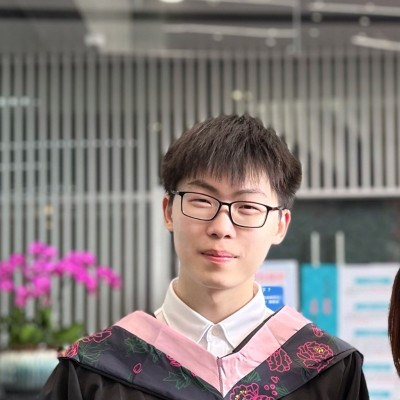
About Me
I am open to job opportunities!
I am currently a final-year Ph.D. student at The Hong Kong Polytechnic University. My research interest focuses on developing and employing operations research tools, including network modeling, optimization, and equilibrium, to understand and enhance transportation systems. I believe transportation serves as a microcosm for understanding the world, and my initial motivation for pursuing operations research is to make a difference to the world.
Education
- Sep 2023 - Now, Ph.D. Student in Transportation, The Hong Kong Polytechnic University
- Sep 2019 - Jul 2023, B.Mgt. in Information Management and Information System, Tongji University
Experiences
- Oct 2026 - Apr 2027, Visiting Student Researcher, IEOR@University of California at Berkeley
- Apr 2023 - May 2023, Algorithm Intern in Operations Research, Cardinal Operations
- May 2021 - Jun 2023, Undergraduate Research Assistant, MSE@Tongji University
Selected Research Works
Working Papers
- Shan Yang, Yuzhen Feng, Xiaolei Wang, Yang Liu, and Yuchen Sun. Designing a forward-looking probabilistic matching policy for dynamic ridepooling service. Reject & Resubmit at Manufacturing & Service Operations Management.
-
Yuzhen Feng, Wei Liu, Guangming Xu, and Hai Yang. High-speed rail capacity allocation and pricing: Flexible ticket or reserved seat? Reject & Resubmit(ted) at Transportation Science.
[abstract]
The rapid expansion of high-speed rail networks and increasing service frequency have greatly improved intercity travel convenience. Travelers are usually required to reserve a specific train in advance. Under uncertainty in the time required to reach the station, they must trade off arriving early and waiting against arriving later and risking missing the reserved train. Flexible tickets can mitigate this problem by allowing travelers to choose a train after arriving at the station. However, limited capacity exposes travelers to denied boarding and creates competition for scarce seats through their endogenous timing choices. We study this trade-off using an equilibrium model in which the operator allocates capacity and sets prices for reserved and flexible tickets, while travelers choose a ticket product and planned arrival time at the station. We establish analytical insights in a two-train setting. First, equilibrium utility of flexible tickets need not decrease with demand. Along an equilibrium branch, higher demand can induce travelers to shift toward later timing, alleviate timing competition, and thereby raise the utility. Second, pure flexible ticketing can be Pareto dominated by pure reserved ticketing because timing competition can dissipate the schedule advantage of preferred trains. This motivates mixed ticketing, for which we characterize conditions under which introducing flexible tickets alongside reserved tickets yields a Pareto improvement over pure reserved ticketing. Third, rationing can improve welfare relative to a no-rationing regime, in which the expected demand of flexible ticket holders for each train does not exceed its allocated capacity. By exposing travelers to the risk of denied boarding, rationing discourages excessively early arrival and can therefore reduce waiting costs. We extend the model to multiple trains and formulate the operator's problem as a mixed integer quadratically constrained program. Numerical experiments show that mixed ticketing can outperform both pure reservation and pure flexibility. In the Hong Kong West Kowloon-Futian case, mixed ticketing increases profit by 16.4% and welfare by 11.2% relative to pure reserved ticketing.
- The 104th Transportation Research Board Annual Meeting, U.S., Jan 2025.
-
Yuzhen Feng, Qingyang Li, Wei Liu, Fangni Zhang, and Jiancheng Long. Resource-constrained user equilibrium. With Referees.
[abstract]
We study user equilibrium with resource constraints (UERC), where users face budgets on energy, time, or risk, motivated by urban mobility, perishable logistics, and itinerary planning. UERC unifies user equilibrium and the resource-constrained shortest path problem by allowing both travel costs and resource consumption to depend on congestion, making path feasibility endogenous. We formulate UERC as a quasi-variational inequality and prove existence when every user has at least one feasible path regardless of congestion; otherwise, deciding existence is NP-hard. We establish uniqueness for parallel-link networks between one origin-destination pair, even under heterogeneous budgets, and show counterexamples where minimal generalizations destroy uniqueness. When cost is proportional to resource consumption on every link, UERC coincides with classical user equilibrium and inherits its uniqueness of link flows. When cost and resource consumption differ but are uniformly comparable, the price of anarchy and unfairness are bounded; without such comparability, both can be unbounded. We also show that increasing budgets can raise total system cost by allowing users to already congested paths. Computationally, we develop a penalty-based algorithm with column generation and prove convergence under the same sufficient condition for existence. Experiments on benchmark networks demonstrate computational scalability and quantify the impact of endogenous feasibility.
Publications
- Yuzhen Feng, and Wei Liu. (2026). Value of modularity against en-route demand uncertainty in bus services. Transportation Research Part C: Emerging Technologies.
- Chen Yang, Xiaolei Wang, Yuzhen Feng, Luohan Hu, Xing Yang, and Zhengbing He. (2024). A prediction-based forward-looking vehicle dispatching strategy for dynamic ride-pooling. IEEE Transactions on Intelligent Transportation Systems.
Others
- Yuzhen Feng. (2026). Time-of-use pump scheduling with switch limit and/or penalty. Available at Optimization Online.
- Yuzhen Feng. (2023). A network modeling approach to assess dynamic en-route ridepooling service (in Chinese). Tongji University.
Selected Awards
- International Collaborative Research Fellowship by The Hong Kong Polytechnic University
- Hong Kong Ph.D. Fellowship by Hong Kong Research Grant Council
- Outstanding Graduate by Shanghai Municipal Education Commission
- National Scholarship by Ministry of Education of the People’s Republic of China
Others
Collaborators
I am grateful to have worked with wonderful coauthors, including many of my peers (listed alphabetically):
- Qingyang Li (Ph.D. student at The University of Hong Kong)
- Chen Yang (JD.com, Ph.D. at Tongji University)
- Shan Yang (Ph.D. at National University of Singapore)